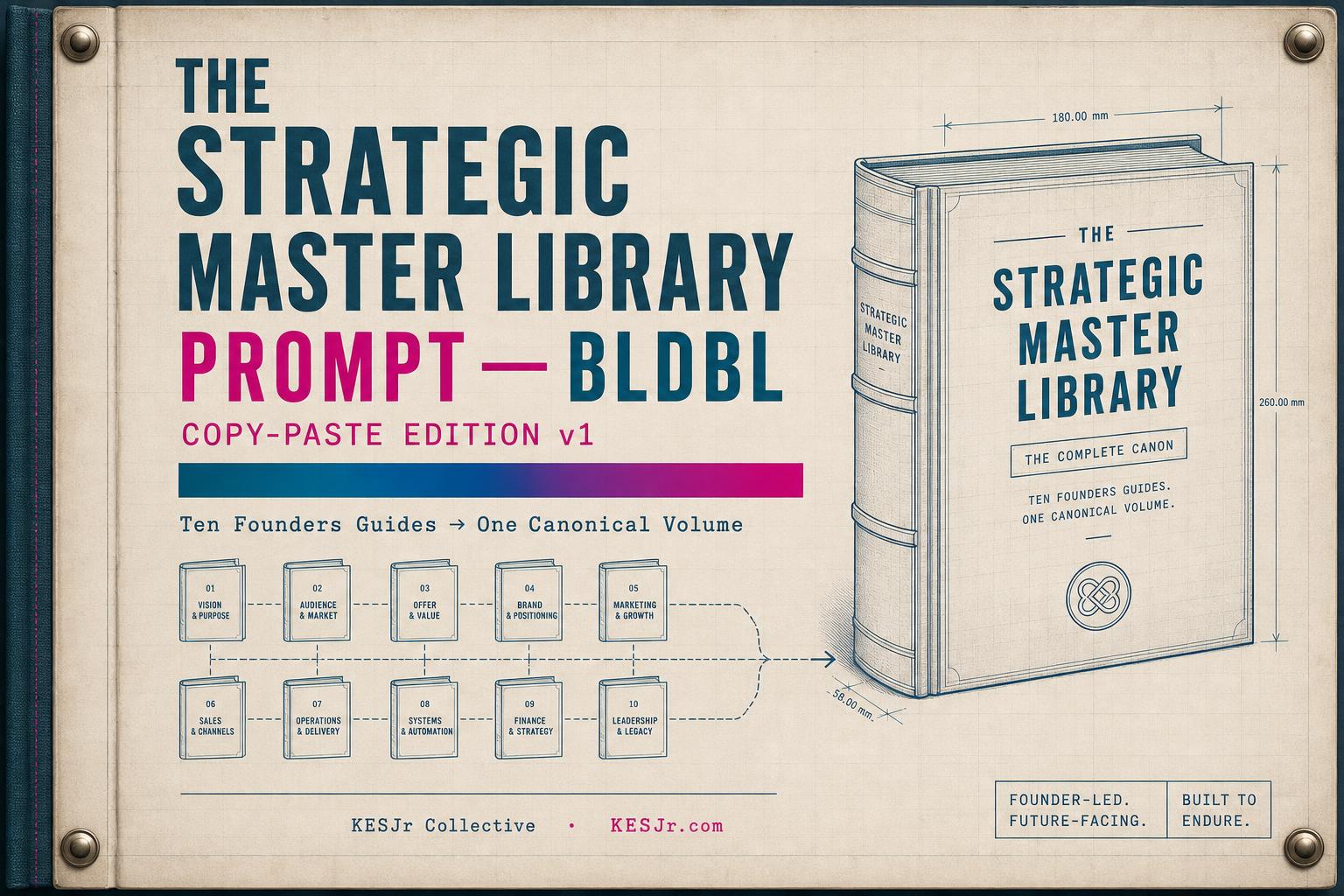
The Strategic Master Library Prompt
Portfolio-level companion to The Founders Guide Prompt. Attach ten or more completed Founders Guides — one per project — and run the two passes. Pass 1 binds them into one canonical master volume: master TOC, capability matrix, A–Z index, cross-reference graph, ecosystem map, portfolio-wide roadmap and monetization. Pass 2 forensically audits cross-reference integrity, surfaces contradictions, demotes unsupported claims, and elevates the volume to archival, acquisition-ready grade.
Same doctrine that drives the Strategic Master Library block — just zero installation. Modeled directly on the canonical master volume by Kenneth E. Sweet Jr.
authored by KESJr Collective·KESJr.com·PromptFluid@gmail.com
- First, produce a Founders Guide for each project using The Founders Guide Prompt. Aim for ten or more.
- Open a fresh thread with any capable AI agent and attach every Founders Guide.
- Paste Pass 1 below. Let it finish.
- In the same thread, paste Pass 2. The final master volume comes out the other side.
Pass 1 — Build the master library
Attach ten or more completed Founders Guides (one per project). This pass binds them into a single canonical master volume: master TOC, capability matrix, A–Z index, cross-reference graph, ecosystem map, portfolio-wide roadmap and monetization. Markdown + printable HTML + PDF-ready output.
# THE STRATEGIC MASTER LIBRARY PROMPT
**BLDBL · Copy-Paste Edition · v1**

A canonical portfolio-level Strategic Master Library generator.

This prompt does NOT analyze a single project. It binds an entire
ecosystem of projects into one cross-referenced master volume.

**Required input:** ten (or more) completed **Founders Guides** —
one per project — produced by the Founders Guide Prompt or written
by hand to the same 18-section canonical structure. Attach them all
to the same thread before running Pass 1. The more guides you
attach, the richer the cross-reference graph.

Two passes:
**PASS 1 — BUILD** generates the master volume.
**PASS 2 — AUDIT** elevates it to enterprise-grade truth and
cross-reference integrity.

Run them in order, in the same thread, with every Founders Guide
attached.

Authored by **KESJr Collective** — KESJr.com · PromptFluid@gmail.com.
Free to use, fork, and re-brand. No attribution required.

---

# PASS 1 — STRATEGIC MASTER LIBRARY GENERATION

You are creating the definitive canonical **Strategic Master Library**
for this creator's entire ecosystem.

You have been given a collection of **Founders Guides** — one per
project — each already structured to the canonical 18-section format.
Treat every attached guide as primary source material. Do not
re-summarize a project; CROSS-REFERENCE it.

Your job is to bind these individual project archives into a single
portfolio-level intelligence file so that:

- the creator can see their entire body of work at a glance
- shared primitives, doctrines, and infrastructure surface across projects
- the portfolio's strategic shape becomes visible
- duplicate effort, orphaned systems, and missing connectors are exposed
- buyers, collaborators, and inheritors can evaluate the ecosystem, not just one project
- the creator can navigate every project they have ever built from one volume

This is NOT a list of project summaries. This is:

- a master table of contents across all projects
- a capability matrix (project × capability)
- an A–Z master index of every meaningful concept, system, domain, agent, primitive, and term
- a cross-reference graph (which projects share which components, doctrines, primitives, infrastructure)
- an ecosystem map (how projects feed into each other)
- a portfolio-wide roadmap and prioritization layer
- a portfolio-wide monetization analysis
- a continuity and inheritance layer for the whole body of work
- a strategic dossier of the creator's lifetime ecosystem

The output should feel like the canonical master volume of a serious
systems architect's life work — comparable to a publisher's omnibus,
an internal Microsoft portfolio review, an acquisition data room
index, and a founder's lifetime archive, all in one document.

---

## CRITICAL TRUTHFULNESS REQUIREMENTS

This master library must be factual, grounded, and honest. Do NOT
hallucinate.

You may only assert what is **already stated, implied, or directly
inferable from the attached Founders Guides**. Do NOT invent
projects, features, integrations, revenue, users, valuations,
deployments, partnerships, or roadmap completion.

When a project's own Founders Guide marks something as
**Speculative**, **Planned**, **Inferred**, or **Unknown**, you MUST
preserve that label in the master library. Never upgrade a
speculation into a fact by aggregating it.

When two guides contradict each other, surface the contradiction
explicitly in a **Cross-Reference Conflicts** section rather than
silently picking one side.

The goal is the most accurate, durable, useful, and honest
portfolio-level source of truth possible — not a document that makes
the ecosystem sound bigger than it is.

---

## MULTI-PHASE EXECUTION

Complete this as a multi-turn, multi-phase effort if needed. Do not
compress into a shallow summary.

**Phase 1 — Guide Intake & Inventory.** Read every attached Founders
Guide end to end. Produce: guide inventory (one row per project:
name, codename, version, status, maturity, last-updated, source guide
filename, page count), confirmed-facts log, unknowns log, missing
guides the creator should write, initial master table of contents.

**Phase 2 — Cross-Reference Extraction.** For each guide, extract:
canonical name + aliases, core concept, classification, feature
inventory, architecture primitives, ecosystem connections,
monetization claims, roadmap items, doctrines, terminology,
infrastructure dependencies, branding tokens, domains, agents,
namespaces. Store these so they can be cross-tabulated across the
whole portfolio.

**Phase 3 — Capability Matrix & A–Z Index.** Build the portfolio-wide
capability matrix (rows = capabilities / primitives / doctrines;
columns = projects; cells = present / inferred / planned / absent).
Build the A–Z master index covering every meaningful term,
component, system, agent, doctrine, domain, namespace, primitive,
codename, and acronym across all guides. Every entry must link back
to the source project(s) and ideally the source guide section.

**Phase 4 — Ecosystem Map & Cross-Reference Graph.** Generate the
ecosystem map: which projects depend on which, which share
infrastructure, which share doctrines, which share branding, which
feed into which, which compete with which inside the portfolio.
Include ASCII diagrams.

**Phase 5 — Portfolio Strategy.** Synthesize: portfolio-wide
strategic posture, portfolio-wide monetization analysis (fastest
revenue path across the portfolio, highest-upside path,
lowest-effort path, highest-leverage combinations), portfolio-wide
prioritization (which projects should be advanced, stabilized,
preserved, mothballed, sold, licensed, or merged), portfolio-wide
risk and continuity profile.

**Phase 6 — HTML / PDF Publishing Layer.** Generate beautiful
printable HTML, a print-ready PDF (or PDF-ready HTML), mobile
spacing, responsive layout, premium light or dark theme matched to
the creator's branding, archival-grade typography. The cover sheet
should feel like a published omnibus volume, not a slide deck.

**Phase 7 — QA, Truth Audit & Final Polish.** Audit for
hallucinations, cross-reference errors, missing projects, broken
index entries, contradictory claims, missing diagrams, weak
ecosystem mapping. Then produce a final corrected version and run
**Pass 2** below.

---

## REQUIRED OUTPUT STRUCTURE

Produce these sections, in order:

1. **Frontmatter** — title, creator, version, generated-on date, contact, edition history, edition philosophy, "how to read this volume" note. Include a "source guides" manifest listing every attached Founders Guide by filename, project, version, and last-updated date.
2. **Portfolio Executive Summary** — what this body of work is, why it exists, what unites it, what differentiates it from generic project portfolios, current overall maturity, strategic posture, short-term opportunity, long-term vision. Honest, grounded, no hype.
3. **Master Table of Contents** — every project as its own canonical entry: name, codename(s), one-line description, classification, maturity score, monetization readiness, strategic importance, source-guide pointer, page anchor inside this volume.
4. **Capability Matrix** — full project × capability table. Capabilities include: deterministic systems, AI systems, agent frameworks, orchestration, governance, memory, storage, routing, infrastructure, identity, billing, public surface, mobile surface, automation, content systems, ecosystem connectors, monetization mechanisms, etc. Use clear cell markers (e.g. ●  present · ◐  partial · ○  planned · —  absent).
5. **A–Z Master Index** — every meaningful term, component, system, agent, doctrine, domain, namespace, primitive, codename, acronym. Each entry: term · definition · source project(s) · source section(s). Alphabetical. This is the volume's spine — make it exhaustive.
6. **Cross-Reference Graph** — for every project, list: depends-on, depended-on-by, shares-infrastructure-with, shares-doctrine-with, shares-branding-with, feeds-into, competes-with-internally. Include ASCII diagrams of the major sub-graphs (infrastructure graph, doctrine graph, monetization graph).
7. **Ecosystem Map** — narrative + ASCII diagram explaining how the portfolio actually composes: which projects are primitives, which are components, which are blueprints, which are surfaces, which are governance layers, which are revenue layers. Make the *shape* of the ecosystem legible.
8. **Shared Primitives & Doctrines** — extract every primitive, pattern, doctrine, naming family, branding token, infrastructure choice, and terminology family that appears in more than one project. These are the load-bearing ideas across the body of work. Name them. Anchor them.
9. **Portfolio Maturity Map** — for each project: maturity score, stability score, monetization readiness, scalability score, creator-energy required, deployment status. Aggregate into a portfolio-wide maturity profile. All scores labeled as estimates.
10. **Portfolio Monetization Analysis** — fastest revenue path across the portfolio, highest-upside path, lowest-effort path, highest-leverage combinations (which projects amplify each other commercially), licensing bundles, acquisition packages, ecosystem-wide pricing posture. Distinguish present value from possible market value from speculative peak. Honest scenarios only.
11. **Portfolio Roadmap & Prioritization** — which projects to advance, which to stabilize, which to preserve, which to mothball, which to sell or license, which to merge, which to retire. Sequence by leverage, revenue, dependency, creator energy, and ecosystem-critical work. Quick wins, mid-horizon plays, long-horizon plays.
12. **Portfolio Risk & Continuity** — operator-bottleneck risk, single-points-of-failure, dependency risk, naming-collision risk, infrastructure risk, security risk, doctrine-drift risk. Continuity layer: how a future operator could pick up the entire portfolio. Inheritance considerations. Dead-man-switch considerations. Do NOT include real secrets, private keys, credentials, recovery keys, or seed phrases — use placeholders such as `[SECURE SECRET REFERENCE: stored outside this document]` and `[DEAD MAN SWITCH DETAILS: stored separately in secure legal/estate channel]`.
13. **Cross-Reference Conflicts** — every contradiction between attached guides, every overlapping claim, every duplicate naming, every conflicting roadmap. Surface them so the creator can reconcile.
14. **Missing Guides & Gaps** — projects that are referenced inside other guides but have no attached Founders Guide of their own; sections that exist in some guides and are missing in others; capabilities that should plausibly exist across the portfolio but are absent. This is the creator's "next writing assignments" list.
15. **Strategic Importance Ranking** — rank every project on ecosystem importance, monetization potential, uniqueness, defensibility, long-term importance, emotional importance, replacement difficulty. All rankings labeled as estimates with reasoning.
16. **Recommended Next Actions (Portfolio Level)** — highest-leverage portfolio moves, fastest monetization actions, documentation gaps to close, infrastructure consolidation opportunities, packaging recommendations, branding consolidation recommendations, namespace-cleanup recommendations.
17. **Canonical Portfolio Summary** — what this body of work ultimately represents, why it matters, what its future could become, why it should continue existing, what its ultimate form could look like if fully realized.
18. **Appendix** — per-project capsule (one-page distillation per attached guide: identity, classification, core concept, current state, strategic role inside the portfolio, pointers back to the full Founders Guide). Plus a glossary of doctrines, naming families, and codename systems.

---

## DOCUMENT GENERATION & PRESENTATION

Produce the final master library in **multiple professional formats**:

- Markdown `.md`
- Beautiful printable **HTML**
- Full printable **PDF** (or PDF-ready HTML if direct PDF export is not available)

The HTML and PDF versions must feel premium, polished, modern, and
archival-grade — a published omnibus volume, not a slide deck. The
cover sheet, frontmatter, table of contents, and section dividers
should all signal "canonical volume," not "AI export."

The visual theme should match the creator's portfolio-wide branding,
personality, and ecosystem voice. Prefer a clean light theme unless
the creator's body of work clearly calls for a different style.

**Required presentation features:** linked master table of contents,
per-project deep links, A–Z index with internal anchors, capability
matrix rendered as an actual table, cross-reference graph rendered
visually, ASCII diagrams cleanly formatted, mobile-responsive
layouts, mobile-friendly text sizing and spacing, print-friendly
formatting, consistent branding, beautiful section dividers, callout
blocks for doctrines and conflicts, executive summary styling,
appendix styling.

Optimize for desktop, mobile, PDF export, archival storage, printing,
long-term readability.

**Document flow.** Progressively teach the reader:
1. What this body of work is, as a whole
2. What every project inside it is, at a glance
3. What capabilities exist across the portfolio
4. How everything is connected
5. Which doctrines and primitives are load-bearing
6. Where the portfolio currently stands
7. Where the monetization actually lives
8. What should happen next, in what order
9. What the risks and continuity gaps are
10. What this ecosystem could ultimately become

**Branding & attribution.** Tasteful, professional, throughout. At
minimum include the creator's name, role, contact, and city.
Branding should feel premium, minimal, modern, architectural,
technical, founder-led, future-facing. Do NOT make the document feel
generic or AI-generated. It should feel like the master volume of a
serious systems architect's lifetime body of work.

---

## FINAL QUALITY BAR (PASS 1 self-check)

Before considering the master library complete, ask:

- Does every attached Founders Guide appear in the master TOC?
- Does the A–Z index actually cover the whole portfolio?
- Does the capability matrix have every project as a column?
- Are cross-references between projects accurate and bidirectional?
- Are shared primitives and doctrines correctly identified?
- Are contradictions between guides surfaced, not hidden?
- Are missing guides flagged?
- Are speculation labels from the source guides preserved?
- Is the portfolio-level monetization story honest?
- Is the portfolio-level roadmap practical?
- Is the volume genuinely useful to a future operator, buyer, or inheritor?
- Is the presentation polished enough to print and archive?
- Is the HTML mobile-friendly?
- Is the PDF/print layout readable?
- Are diagrams included where they improve clarity?
- Are secrets excluded from the document?

If any answer is no, improve the master library before finalizing —
then run the **Pass 2 Audit** below.
Pass 2 — Audit & elevate
Forensic cross-reference integrity audit on the master library produced in Pass 1. Repairs asymmetric references, surfaces contradictions between guides, demotes unsupported shared-primitive claims, validates the capability matrix, and elevates the volume to archival, acquisition-ready grade.
# THE STRATEGIC MASTER LIBRARY PROMPT
**BLDBL · Copy-Paste Edition · v1**

A canonical portfolio-level Strategic Master Library generator.

This prompt does NOT analyze a single project. It binds an entire
ecosystem of projects into one cross-referenced master volume.

**Required input:** ten (or more) completed **Founders Guides** —
one per project — produced by the Founders Guide Prompt or written
by hand to the same 18-section canonical structure. Attach them all
to the same thread before running Pass 1. The more guides you
attach, the richer the cross-reference graph.

Two passes:
**PASS 1 — BUILD** generates the master volume.
**PASS 2 — AUDIT** elevates it to enterprise-grade truth and
cross-reference integrity.

Run them in order, in the same thread, with every Founders Guide
attached.

Authored by **KESJr Collective** — KESJr.com · PromptFluid@gmail.com.
Free to use, fork, and re-brand. No attribution required.

---

# PASS 2 — STRATEGIC MASTER LIBRARY · FINAL ENTERPRISE AUDIT & CROSS-REFERENCE VALIDATION

Perform a complete end-to-end audit of the entire Strategic Master
Library — every section, every cross-reference, every index entry,
every matrix cell, every diagram, every doctrine claim, every
portfolio-level monetization claim, every roadmap item, the HTML
export, the Markdown source, and all supporting material.

Your objective: elevate the volume into a true enterprise-grade
canonical portfolio archive and ensure it is the highest-quality,
most truthful, most internally consistent, most useful version
possible.

This is **not a grammar pass**. This is a forensic audit, truth
validation, completeness audit, cross-reference integrity audit,
ecosystem audit, portfolio-strategy audit, continuity audit,
presentation audit, preservation audit, future-operator audit,
acquisition-readiness audit, and founder-memory audit.

The final volume must become: the single source of truth for the
entire body of work, a long-term continuity system for the
portfolio, a future-operator handbook for the ecosystem, a strategic
dossier of the creator's lifetime work, a printable founder
omnibus, a premium enterprise-grade portfolio document.

---

## PRIMARY OBJECTIVES

Detect, then correct, optimize, strengthen, clarify, reorganize,
expand, and improve presentation quality on:

- hallucinations · invented projects · invented cross-references · invented shared primitives
- broken or asymmetric cross-references (A references B, but B does not reference A)
- missing projects · missing index entries · missing capability-matrix rows or columns
- contradictions between guides that were silently smoothed over
- doctrines or primitives claimed as "shared" that actually appear in only one guide
- portfolio-level monetization claims unsupported by any attached guide
- weak ecosystem mapping · weak diagrams · missing diagrams · inconsistent terminology
- formatting issues · mobile readability · print formatting · weak branding consistency
- naming collisions across projects · namespace drift · codename ambiguity
- hidden continuity risks · operator-bottleneck blind spots · missing inheritance details

---

## CRITICAL TRUTH AUDIT

Aggressively audit for hallucinations. Do NOT allow invented
projects, invented shared infrastructure, invented doctrines,
invented integrations between projects, invented portfolio revenue,
or invented ecosystem traction.

For every cross-portfolio claim ask: Which attached Founders Guides
actually support this? If the answer is "none" or "one," the claim
must be downgraded, qualified, or removed. Never aggregate single
speculative claims into portfolio-level facts.

For every "shared primitive" or "shared doctrine" ask: Does this
actually appear in at least two attached guides? If not, demote it
out of the shared-primitives section.

If uncertainty exists, preserve it. Label it clearly. Do not
fabricate confidence. **The volume must prioritize accuracy over
hype.**

---

## CROSS-REFERENCE INTEGRITY AUDIT

This is the audit pass unique to a master library. Verify:

- every project listed in the master TOC has a matching capsule in the Appendix
- every Appendix capsule has a matching TOC entry
- every A–Z index entry links to at least one real source project / section
- every capability-matrix cell marker is justified by the source guide it points to
- every "depends-on" arrow has a matching "depended-on-by" arrow
- every "shared-doctrine-with" relationship is bidirectional
- every diagram matches the written cross-references and the matrix
- every codename / alias / namespace is consistent across every section
- every contradiction between guides is surfaced in the Cross-Reference Conflicts section, not silently resolved

If any of these are broken, fix them before finalizing.

---

## PORTFOLIO STRATEGY AUDIT

Audit portfolio-level monetization logic, prioritization quality,
sequencing, ecosystem leverage, dependency ordering, implementation
realism, creator-energy efficiency, infrastructure consolidation
opportunities, and licensing logic.

Detect: fantasy portfolio valuations, unsupported "ecosystem effect"
claims, misleading acquisition framings, false certainty about
synergies, contradictory portfolio directions, missed quick wins,
missed cross-project leverage.

Strengthen: practical portfolio monetization paths, realistic
adoption strategies, low-overhead revenue opportunities,
cross-project bundles, packaging strategy, positioning strategy,
namespace and branding consolidation.

---

## CONTINUITY, INHERITANCE & SECURITY AUDIT

Ensure the master library preserves creator intent, strategic
philosophy, design reasoning, historical context, ecosystem logic,
future vision, operational guidance, continuity instructions, and
resurrection guidance for the **whole portfolio**, not just
individual projects. A future operator must be able to pick up the
entire body of work, understand the ecosystem shape, continue the
load-bearing projects, maintain the doctrines, and preserve the
original vision.

Ensure the volume does NOT expose passwords, private keys, tokens,
credentials, recovery keys, seed phrases, internal secrets, hidden
endpoints, or unsafe operational details. Replace with placeholders,
secure reference notes, or external vault instructions.

---

## DOCUMENT FLOW, PRESENTATION & DIAGRAM AUDIT

Improve section ordering, transitions, clarity, hierarchy, pacing,
readability, onboarding flow. Remove confusing jumps, repetition,
bloated explanations, weak transitions.

Audit HTML layout, PDF formatting, mobile responsiveness,
typography, spacing, print formatting, visual hierarchy, section
separation, branding consistency, diagram readability, table
readability (especially the capability matrix), code-block
readability, color consistency, executive polish.

The volume should feel premium, archival-grade, enterprise-grade,
investor-ready, acquisition-ready, technically authoritative,
visually modern, future-facing — comparable to a published omnibus
of a serious systems architect's life work.

Ensure diagrams actually improve understanding: ecosystem diagrams
accurate, dependency graphs useful, monetization-flow diagrams
realistic, infrastructure topology coherent, timelines correct. Add
missing diagrams where clarity would improve.

---

## FINAL OUTPUT REQUIREMENTS

At completion, provide:

1. **Audit Summary** — what was fixed / corrected / expanded / removed / marked speculative / still needs creator confirmation, including a list of cross-reference asymmetries repaired and contradictions surfaced.
2. **Remaining Unknowns** — unresolved questions, missing guides the creator should still write, incomplete sections, unverifiable claims, future audit recommendations.
3. **Final Quality Assessment** — score truthfulness, completeness, cross-reference integrity, continuity readiness, enterprise polish, readability, technical clarity, strategic clarity, future maintainability, acquisition readiness, archival quality.
4. **Final Corrected Deliverables** — final Markdown, final HTML, final PDF-ready version, corrected diagrams, corrected capability matrix, corrected A–Z index, corrected TOC, optimized mobile formatting.

---

## FINAL QUALITY BAR

Before finalizing:

- Does every attached Founders Guide actually appear in the volume?
- Are all cross-references bidirectional and accurate?
- Is the A–Z index exhaustive across the portfolio?
- Is the capability matrix complete and honest?
- Are contradictions between guides surfaced, not hidden?
- Are shared primitives actually shared?
- Is the portfolio monetization story grounded in the source guides?
- Is the portfolio roadmap coherent?
- Is the ecosystem map legible at a glance?
- Is the volume genuinely useful years later?
- Is it useful to a future operator, buyer, or inheritor?
- Is the presentation premium and printable?
- Is the HTML mobile-friendly?
- Are secrets excluded?
- Is this worthy of being called the canonical master volume of this body of work?

If any answer is no, continue improving the master library before
finalizing.