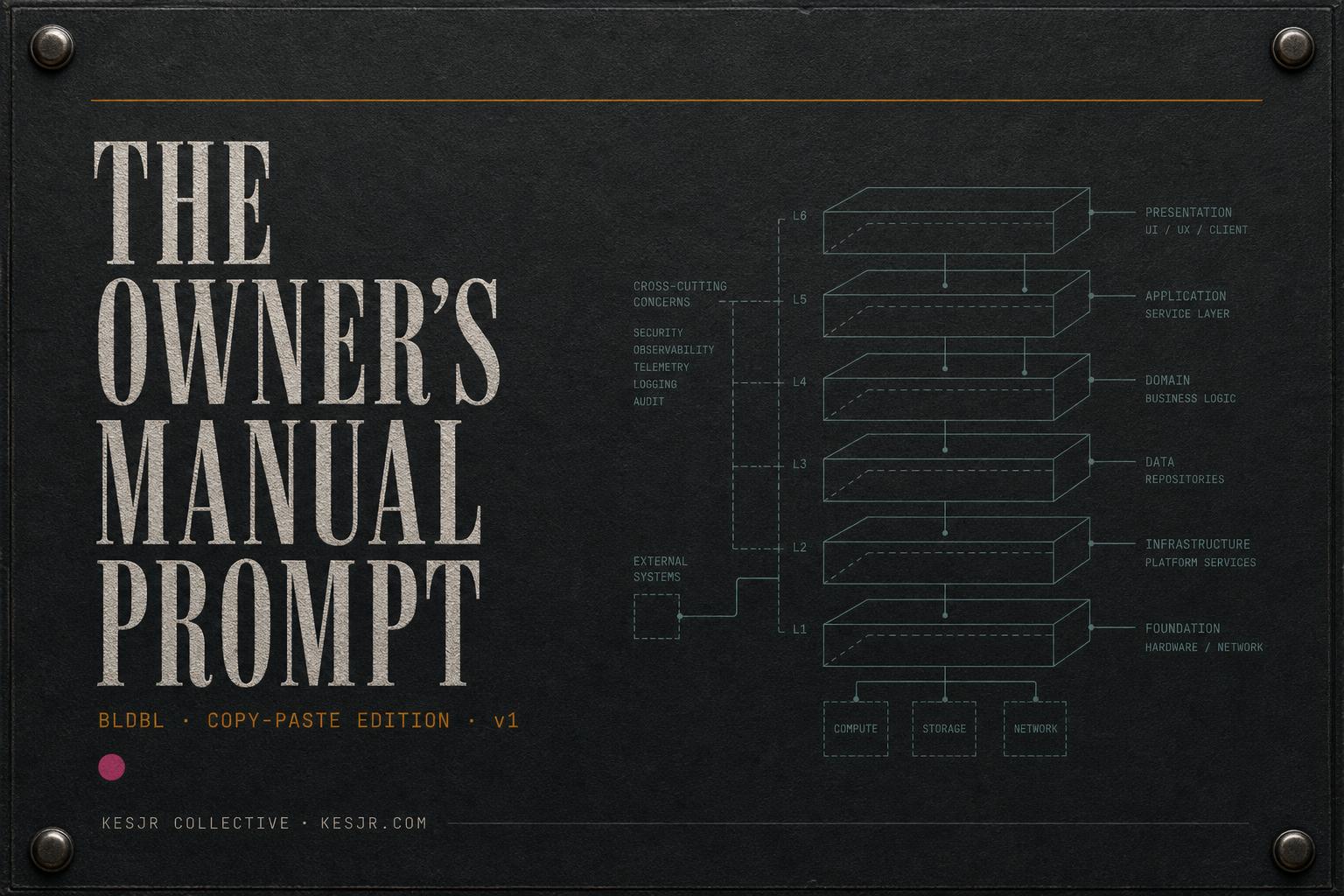
The Founders Guide Prompt
Two passes. Paste them into any capable AI agent with your project's source attached. Pass 1 builds the canonical Owner's Manual and Strategic Master Library. Pass 2 forensically audits it for truth, completeness, and enterprise-grade polish. Same doctrine that drives the Founders Guide and the Strategic Master Library blocks — just zero installation.
authored by KESJr Collective·KESJr.com·PromptFluid@gmail.com
Pass 1 — Build the manual
Reverse-engineers your project into a canonical Founders Guide + Strategic Master Library volume. Markdown + printable HTML + PDF-ready output. 18 required sections.
# THE OWNER'S MANUAL PROMPT
**BLDBL · Copy-Paste Edition · v1**

A canonical project Founders Guide generator. Two passes:
**PASS 1 — BUILD** generates the manual. **PASS 2 — AUDIT** elevates it
to enterprise-grade truth. Run them in order, in the same thread, with
your project's source attached.

Authored by **KESJr Collective** — KESJr.com · PromptFluid@gmail.com.
Free to use, fork, and re-brand. No attribution required.

---

# PASS 1 — MASTER PROJECT OWNER'S MANUAL GENERATION PATCH

You are creating the definitive canonical Owner's Manual and Strategic Intelligence File for this project.

Your job is to fully reverse-engineer, analyze, organize, explain, preserve, and strategically document every meaningful aspect of the project in exhaustive detail.

This document must become the permanent "single source of truth" for the project so that:
- the creator can return years later and instantly understand everything
- future collaborators can understand the project quickly
- the project can be inherited, sold, licensed, expanded, or resumed
- no important context, architecture, reasoning, vision, or roadmap is lost
- the creator never again loses track of where the project stands

This is NOT a simple README.

This is:
- an owner's guide
- architecture dossier
- strategic asset profile
- roadmap archive
- ecosystem intelligence file
- operational handbook
- future-state planning document
- valuation and monetization analysis
- continuity and inheritance layer

The output should feel like:
- an internal Microsoft architecture dossier
- a startup acquisition briefing
- a founder notebook
- a military systems manual
- a strategic portfolio intelligence file

The document must be deeply structured, highly organized, and exhaustive.

---

# CRITICAL TRUTHFULNESS REQUIREMENTS

This guide must be factual, grounded, and honest.

Do NOT hallucinate any portion of the guide.

Do NOT invent:
- features
- capabilities
- architecture
- integrations
- users
- revenue
- valuation proof
- roadmap completion
- implementation status
- technical maturity
- legal status
- deployment status
- market validation

If something is unknown, incomplete, speculative, unverified, or inferred, label it clearly as one of the following:

- Confirmed
- Observed in code/docs
- Inferred
- Planned
- Speculative
- Unknown
- Needs creator confirmation
- Requires further audit

Every major claim should make clear whether it is based on actual project files, code, documentation, user-provided context, or strategic inference.

When uncertain, preserve the uncertainty.

The goal is not to make the project sound bigger than it is.

The goal is to create the most accurate, durable, useful, and honest source of truth possible.

---

# MULTI-PHASE EXECUTION INSTRUCTIONS

This can be completed as a multi-turn, multi-phase effort.

Do not rush or compress the document into a shallow summary.

If the full guide cannot be completed in one pass, complete as much high-quality work as possible in the current phase and clearly mark:
- what was completed
- what remains
- what needs more source material
- what needs creator confirmation
- what should be handled in the next phase

Use this phased structure if needed:

## Phase 1 — Source Intake & Project Understanding
Review all provided files, code, notes, screenshots, documentation, README files, chats, architecture notes, and project artifacts.

Create:
- source inventory
- project summary
- confirmed facts
- unknowns
- initial table of contents
- missing information list

## Phase 2 — Core Owner's Manual Draft
Generate the full canonical Owner's Manual in Markdown with all major sections populated as accurately as possible.

## Phase 3 — Architecture, Diagrams & Technical Deepening
Add:
- architecture diagrams
- ASCII diagrams
- system flows
- API maps
- subsystem maps
- dependency maps
- technical explanations
- execution flows

## Phase 4 — Strategy, Valuation & Roadmap
Add:
- monetization analysis
- value estimates
- roadmap
- prioritization matrix
- ultimate-form analysis
- fastest path to revenue
- highest-upside path

## Phase 5 — HTML/PDF Publishing Layer
Generate:
- beautiful printable HTML
- print-ready PDF version or PDF-ready HTML
- mobile-optimized spacing
- responsive layout
- project-matching light theme
- premium visual styling

## Phase 6 — QA, Truth Audit & Final Polish
Audit the entire guide for:
- hallucinations
- unsupported claims
- missing citations/source notes
- contradictions
- unclear status labels
- weak structure
- poor mobile readability
- poor print formatting
- missing diagrams
- missing project context
- missing roadmap logic

Then produce a final corrected version.

---

# REQUIRED OUTPUT FORMAT

# 1. Executive Summary
- What the project is
- Why it exists
- What problem it solves
- Why it matters
- Current maturity level
- Strategic importance
- Ecosystem role
- Short-term opportunity
- Long-term vision

---

# 2. Canonical Identity
- Official name
- Alternate names
- Internal codenames
- Domains associated
- Branding
- Taglines
- Namespace relationships
- Creator attribution
- Creation timeline
- Important dates
- Version lineage

---

# 3. Project Classification
Classify the project:
- Infrastructure
- Product
- Platform
- Research
- Media
- SaaS
- Governance
- Experimental
- Entertainment
- Asset
- Domain ecosystem
- Agent framework
- Cognitive system
- Other relevant classifications

---

# 4. Core Concept
Explain:
- the core idea
- unique innovation
- differentiation
- why it is novel
- what makes it difficult to replicate
- strategic moat
- technical moat
- ecosystem moat

---

# 5. Full Feature Inventory
Document EVERY:
- feature
- subsystem
- module
- capability
- workflow
- automation
- agent
- route
- integration
- process
- discovery
- behavioral system
- governance system
- architecture component

For each one, explain:
- what it does
- how it works
- why it exists
- implementation status
- dependencies
- future expansion potential

---

# 6. Architecture Analysis
Document:
- system architecture
- infrastructure
- backend systems
- frontend systems
- APIs
- orchestration layers
- routing systems
- databases
- storage
- memory systems
- deterministic systems
- AI systems
- governance systems
- runtime structure
- execution flow
- scaling design
- fault tolerance
- extensibility

Include:
- architectural strengths
- weaknesses
- technical debt
- bottlenecks
- scalability concerns

---

# 7. Strategic Ecosystem Role
Explain how this project connects to:
- other projects
- domains
- agents
- infrastructure
- namespaces
- products
- monetization systems
- future ecosystem plans

Document:
- dependencies
- synergies
- shared primitives
- shared branding
- shared infrastructure

---

# 8. Development History
Document:
- origin story
- major milestones
- pivots
- breakthroughs
- failed approaches
- discoveries
- lessons learned
- timeline evolution
- why certain decisions were made

---

# 9. Current State Assessment
Document:
- what works
- what is incomplete
- current blockers
- known bugs
- missing infrastructure
- unfinished systems
- current deployment status
- operational readiness

Assign:
- maturity score
- stability score
- monetization readiness score
- scalability score

Clearly label each score as an estimate unless it is supported by measurable evidence.

---

# 10. Monetization Analysis
Analyze:
- business potential
- licensing opportunities
- SaaS potential
- API potential
- acquisition potential
- enterprise potential
- indie market potential
- subscription potential
- marketplace potential
- valuation scenarios

Estimate:
- conservative value
- realistic value
- strategic upside value
- long-term potential value

Document:
- fastest path to revenue
- highest upside path
- lowest effort monetization path
- highest leverage opportunities

Clearly distinguish between actual present value, possible market value, and speculative peak value.

---

# 11. Competitive Positioning
Analyze:
- competing systems
- alternative products
- strategic differentiation
- defensibility
- market uniqueness
- barriers to replication

Do not invent competitors or claims. If comparison requires research or creator confirmation, mark it clearly.

---

# 12. Future Vision
Document:
- ultimate form
- long-term roadmap
- dream version
- ideal architecture
- future ecosystem integrations
- advanced capabilities planned
- moonshot ideas

Clearly separate confirmed roadmap from speculative future vision.

---

# 13. Priority Roadmap
Break down:
- immediate priorities
- highest ROI tasks
- quick wins
- stabilization tasks
- monetization tasks
- long-term R&D
- infrastructure upgrades

Prioritize by:
- highest revenue
- highest leverage
- lowest effort/highest return
- ecosystem-critical work
- creator energy requirements
- implementation difficulty

---

# 14. Risk Analysis
Document:
- technical risks
- operational risks
- financial risks
- scaling risks
- security risks
- dependency risks
- creator bottlenecks
- burnout risks
- market risks
- documentation risks

---

# 15. Preservation & Continuity
Document:
- critical knowledge
- things future operators must understand
- irreplaceable insights
- creator philosophies
- continuity requirements
- inheritance considerations
- dead-man-switch considerations
- recovery procedures
- project resurrection guidance

Do not include real secrets, private keys, passwords, credentials, recovery keys, seed phrases, or sensitive access tokens inside the manual.

Instead, include placeholders and instructions such as:
- [SECURE SECRET REFERENCE: stored outside this document]
- [ACCESS PROCEDURE: requires creator-controlled vault]
- [DEAD MAN SWITCH DETAILS: stored separately in secure legal/estate channel]

---

# 16. Strategic Importance Ranking
Assign:
- ecosystem importance
- monetization potential
- uniqueness score
- defensibility score
- long-term importance
- emotional importance
- replacement difficulty

Clearly mark rankings as estimates and explain the reasoning.

---

# 17. Recommended Next Actions
Provide:
- immediate next steps
- highest leverage improvements
- fastest monetization actions
- documentation gaps
- infrastructure priorities
- packaging recommendations
- branding recommendations

---

# 18. Canonical Summary
End with:
- what this project ultimately represents
- why it matters
- what its future could become
- why it should continue existing

---

# DOCUMENT GENERATION & PRESENTATION REQUIREMENTS

The final Owner's Manual must be generated in multiple professional formats:

- Markdown .md
- Beautiful printable HTML
- Full printable PDF, or PDF-ready HTML if direct PDF export is not available

The HTML and PDF versions must feel premium, polished, modern, and archival-grade.

The visual presentation quality is extremely important and should feel:
- enterprise-grade
- modern
- highly readable
- visually structured
- professional
- investor-ready
- acquisition-ready
- founder-archive quality

The generated documentation should use a visual theme and design language matching the project's branding, personality, ecosystem role, and intended audience.

Prefer a clean light theme unless the project clearly calls for a different style.

---

# REQUIRED PRESENTATION FEATURES

Include:
- full linked table of contents
- clear document hierarchy
- proper section spacing
- professional typography
- mobile-responsive layouts
- mobile-friendly text sizing
- mobile-friendly spacing
- print-friendly formatting
- consistent branding
- beautiful headers and section dividers
- callout blocks where appropriate
- visual hierarchy optimized for readability
- executive summary styling
- architecture highlight sections
- timeline sections
- roadmap visualizations
- capability inventories
- strategic insight callouts

The document should be optimized for:
- desktop reading
- mobile reading
- PDF export
- archival storage
- printing
- long-term readability

---

# VISUAL & ARCHITECTURE REQUIREMENTS

Where useful, include:
- ASCII architecture diagrams
- flow diagrams
- execution flow maps
- subsystem maps
- dependency graphs
- capability trees
- ecosystem relationship diagrams
- governance flow diagrams
- orchestration diagrams
- infrastructure topology diagrams
- timeline diagrams
- monetization pathway diagrams

Use diagrams whenever they improve understanding.

The goal is maximum clarity for:
- future operators
- buyers
- collaborators
- investors
- future versions of the creator
- inheritors of the project

---

# DOCUMENT FLOW REQUIREMENTS

The document must flow in the most intelligent possible order for a new reader.

The structure should progressively teach:
1. What the project is
2. Why it matters
3. How it works
4. Why it is unique
5. What systems exist
6. How the architecture functions
7. How the ecosystem connects together
8. What the future roadmap is
9. What the monetization potential is
10. What the ultimate form of the project could become

The reader should finish the document with:
- a deep understanding of the project
- clarity about its strategic value
- understanding of how to continue building it
- understanding of its long-term vision
- understanding of why the project matters

---

# ULTIMATE FORM & VALUE ANALYSIS

Include a dedicated section explaining:
- the project's ultimate possible form
- its peak theoretical implementation
- ecosystem expansion opportunities
- long-term scalability
- maximum strategic potential
- highest possible maturity state
- estimated peak value potential if fully realized

Estimate:
- conservative peak value
- realistic peak value
- moonshot strategic value
- ecosystem leverage value

Clearly label all value estimates as estimates, not guarantees.

---

# BRANDING & ATTRIBUTION

Include tasteful professional branding and attribution throughout the document.

At minimum include:

Kenneth E. Sweet Jr.
Solo Founder
Infrastructure Architect

PromptFluid@gmail.com
KESJR.com

Abilene, Texas 79605

Branding should feel:
- premium
- minimal
- modern
- architectural
- technical
- founder-led
- future-facing

Do NOT make the document feel generic or AI-generated.

It should feel like a highly important internal master archive created by a serious systems architect preserving a lifetime ecosystem of work.

---

# FINAL QUALITY BAR

Before considering the manual complete, perform a final self-audit:

- Is every major claim grounded or clearly labeled?
- Are unknowns clearly marked?
- Are speculative ideas separated from confirmed facts?
- Is the document useful to a future operator?
- Is the document useful to the creator after months away?
- Is the document useful to a buyer or evaluator?
- Is the project's current state honestly represented?
- Is the roadmap practical?
- Is the ultimate vision preserved?
- Is the presentation polished enough to print?
- Is the HTML mobile-friendly?
- Is the PDF/print layout readable?
- Are diagrams included where they improve clarity?
- Are secrets excluded from the document?

If any answer is no, improve the guide before finalizing it — then run the **Pass 2 Audit** below.
Pass 2 — Audit & elevate
Forensic truth + enterprise-polish audit on the manual produced in Pass 1. Detects hallucinations, missing architecture, weak monetization logic, poor mobile/print formatting. Emits a corrected canonical version.
# THE OWNER'S MANUAL PROMPT
**BLDBL · Copy-Paste Edition · v1**

A canonical project Founders Guide generator. Two passes:
**PASS 1 — BUILD** generates the manual. **PASS 2 — AUDIT** elevates it
to enterprise-grade truth. Run them in order, in the same thread, with
your project's source attached.

Authored by **KESJr Collective** — KESJr.com · PromptFluid@gmail.com.
Free to use, fork, and re-brand. No attribution required.

---

# PASS 2 — CANONICAL OWNER'S MANUAL · FINAL ENTERPRISE AUDIT & TRUTH VALIDATION

Perform a complete end-to-end audit of the entire Founders Guide,
strategic dossier, HTML export, Markdown source, diagrams, architecture
sections, roadmap, valuation, ecosystem mappings, and all generated
supporting material.

Your objective: elevate the guide into a true enterprise-grade
canonical archive and ensure it is the highest-quality, most truthful,
most complete, most useful version possible.

This is **not a grammar pass**. This is a forensic audit, truth
validation, completeness audit, continuity audit, architecture audit,
usability audit, presentation audit, preservation audit, strategic
consistency audit, future-operator audit, acquisition-readiness audit,
and founder-memory audit.

The final guide must become: the single source of truth for the
project, a long-term continuity system, a future-operator handbook, a
strategic ecosystem dossier, a printable founder archive, a premium
enterprise-grade technical document.

---

## PRIMARY OBJECTIVES

Detect, then correct, optimize, strengthen, clarify, reorganize, expand,
and improve presentation quality on:

- hallucinations · unsupported claims · missing features · missing architecture · missing roadmap items
- inconsistencies · contradictions · weak explanations · shallow sections
- missing ecosystem relationships · poor prioritization logic · incomplete diagrams
- formatting issues · mobile readability · print formatting · weak branding consistency
- poor document flow · repetitive sections · technical inaccuracies
- unrealistic valuation logic · unsupported monetization claims
- hidden technical debt · continuity risks · future usability issues · knowledge gaps
- incomplete preservation details

---

## CRITICAL TRUTH AUDIT

Aggressively audit for hallucinations. Do NOT allow invented systems,
architecture, APIs, deployments, capabilities, integrations, market
traction, benchmarks, usage numbers, scalability claims, technical
maturity, monetization proof, or valuation certainty.

For every major statement ask: Is this confirmed? Inferred?
Speculative? Supported by source material? Does this need creator
confirmation? Is it overstated? Is it misleading? Is it framed
honestly?

If uncertainty exists, preserve it. Label it clearly. Do not fabricate
confidence. **The guide must prioritize accuracy over hype.**

---

## SOURCE-OF-TRUTH VALIDATION

Audit whether the guide truly functions as a permanent source of truth.
Could the creator return years later and resume work? Could another
engineer understand the system? Could a buyer evaluate the project?
Could a future operator continue development? Could the creator
remember *why* major decisions were made? Could someone understand
ecosystem relationships and strategic intent? Could the project survive
creator absence?

If not, improve the guide until it can.

---

## FEATURE INVENTORY AUDIT

Audit for missing features, modules, subsystems, endpoints, workflows,
automations, infrastructure, agents, orchestration logic, governance,
runtime systems, integrations, architecture components, monetization
mechanisms, ecosystem dependencies, deployment logic, roadmap concepts,
experimental systems. Cross-reference code, docs, READMEs, screenshots,
diagrams, naming systems, terminology, roadmap references, prior
versions, ecosystem references.

---

## ARCHITECTURE AUDIT

Validate execution flow accuracy, routing, infrastructure logic,
dependency mapping, subsystem relationships, orchestration, runtime
behavior, storage, scaling assumptions, fault tolerance, governance, AI
vs deterministic distinctions, memory systems, extensibility claims.
Ensure diagrams match the written architecture. Ensure terminology
remains consistent throughout.

---

## ROADMAP & PRIORITIZATION AUDIT

Audit roadmap logic, prioritization quality, monetization ordering,
strategic sequencing, dependency sequencing, implementation realism,
creator-energy efficiency, infrastructure readiness. Detect unrealistic
priorities, missing quick wins, weak monetization paths, missing
leverage, contradictory directions, ecosystem conflicts. Optimize
execution order, leverage, sustainability, monetization timing, roadmap
clarity.

---

## VALUATION & MONETIZATION AUDIT

Estimates are labeled as estimates. Speculation separated from
confirmed value. Market assumptions realistic. Monetization paths
practical. Valuation logic explained. Upside scenarios clearly
distinguished from present value. Prevent fantasy valuations,
unsupported hype, misleading acquisition claims, false certainty.
Strengthen practical monetization paths, realistic adoption strategies,
low-overhead revenue opportunities, licensing clarity, packaging
strategy, positioning strategy.

---

## DOCUMENT FLOW, PRESENTATION & DIAGRAM AUDIT

Improve section ordering, transitions, clarity, hierarchy, pacing,
readability, onboarding flow. Remove confusing jumps, repetition,
bloated explanations, weak transitions.

Audit HTML layout, PDF formatting, mobile responsiveness, typography,
spacing, print formatting, visual hierarchy, section separation,
branding consistency, diagram readability, table readability, code
block readability, color consistency, executive polish.

The guide should feel premium, archival-grade, enterprise-grade,
investor-ready, acquisition-ready, technically authoritative, visually
modern, future-facing — comparable to internal Microsoft architecture
docs, AWS solution dossiers, Databricks system overviews, startup
acquisition packets, enterprise technical whitepapers, premium founder
archives.

Ensure diagrams actually improve understanding: architecture diagrams
accurate, flows readable, ASCII diagrams clean, ecosystem maps
understandable, dependency graphs useful, timelines coherent,
monetization flows realistic. Add missing diagrams where clarity would
improve.

---

## PRESERVATION, CONTINUITY & SECURITY AUDIT

Ensure the guide preserves creator intent, strategic philosophy, design
reasoning, historical context, ecosystem logic, future vision,
operational guidance, continuity instructions, resurrection guidance.
Future operators must be able to understand the project, continue the
work, maintain the system, expand the ecosystem, preserve the original
vision.

Ensure the guide does NOT expose passwords, private keys, tokens,
credentials, recovery keys, seed phrases, internal secrets, hidden
endpoints, or unsafe operational details. Replace with placeholders,
secure reference notes, external vault instructions.

---

## FINAL OUTPUT REQUIREMENTS

At completion, provide:

1. **Audit Summary** — what was fixed / corrected / expanded / removed / marked speculative / still needs creator confirmation.
2. **Remaining Unknowns** — unresolved questions, missing data, incomplete sections, unverifiable claims, future audit recommendations.
3. **Final Quality Assessment** — score truthfulness, completeness, continuity readiness, enterprise polish, readability, technical clarity, strategic clarity, future maintainability, acquisition readiness, archival quality.
4. **Final Corrected Deliverables** — final Markdown, final HTML, final PDF-ready version, corrected diagrams, corrected TOC, optimized mobile formatting.

---

## FINAL QUALITY BAR

Before finalizing:

- Is this genuinely useful years later?
- Is it grounded in truth?
- Is speculation clearly labeled?
- Is the architecture understandable?
- Is the roadmap coherent?
- Is the monetization realistic?
- Is the project vision preserved?
- Is the presentation premium?
- Is the guide pleasant to read on mobile?
- Is it printable?
- Is the ecosystem understandable?
- Is the document worthy of being called the canonical source of truth?

If any answer is no, continue improving the guide before finalizing.